
Sometime in the last decade, the hyperlocal commerce industry made a collective decision.
It decided that the problem worth solving was speed.
How fast can a product move from a nearby store to a customer's door? How efficiently can a delivery route be optimised? How quickly can a vendor confirm, pack, and dispatch?
These are real problems. They got real solutions. The infrastructure built to solve them is genuinely impressive.
But in the process, a different question, arguably the more important one, was left untouched.
“How does someone find a local business worth visiting in the first place?”
What a Decade of Hyperlocal Investment Built
$1.7T
Hyperlocal commerce market, 2020
Allied Market Research
$5.2T
Projected market size by 2030
14.9% CAGR
214M
Hyperlocal service users in India by 2022
IAMAI, 2023
The platforms and infrastructure that powered this growth were overwhelmingly built around one thing: fulfilling an order that had already been placed. Geolocation routing. Multi-zone delivery management. Real-time tracking. Vendor dashboards. Delivery partner apps. Payment integrations. The entire stack, from the moment a customer taps 'buy' to the moment the product arrives, engineered with precision.
It is an impressive feat of logistics infrastructure. And it begins at entirely the wrong moment.
The Moment That Was Never Addressed
Before any order is placed, something else happens. A person wonders where to buy something. They think about which store is worth the trip. They try to remember if a friend mentioned a place. They search, scroll, give up, or settle. They make a decision, or they don't, based on incomplete information about what exists around them.
This is the pre-discovery moment. And for local commerce, it is the moment that matters most. The delivery infrastructure assumes a consumer who already knows what they want and where to get it. In practice, an enormous portion of local commerce never happens because consumers couldn't find or evaluate their options in the first place.
Discovery Layer
How consumers find what's worth visiting, before any intent to buy
Transaction Layer
The moment of purchase: checkout, payment, order confirmation
Fulfillment Layer
What happens after purchase: the last mile
The hyperlocal stack: two of three layers exist. The first one doesn't.
60M
Local businesses operating in India
Ministry of MSME, India
<3%
Are meaningfully discoverable online
97%
Exist, but are functionally invisible to most potential customers
Consider what this means on the ground in any Indian metro. These aren't failing businesses. They have products, services, and customers. They're just invisible, accessible only to people within walking distance or word-of-mouth range.
The pre-discovery moment, 'I wonder what's actually worth visiting near me,' has no platform built for it.
Why Discovery Was Left Behind
The answer is partly structural. Discovery is a harder problem to monetise at early stage. Delivery has a clear transaction to capture: an order is placed, a commission is earned. Discovery is upstream of that transaction, and the value it creates is diffuse: awareness, intent, footfall, trust. Harder to attribute. Harder to turn into a series A revenue model.
Why Delivery Got Built
Clear transaction to capture. Commission per order. Engineering precedents in logistics and routing. Metrics that made sense to early investors: orders per hour, delivery time, unit economics per zone.
Why Discovery Was Skipped
Diffuse value: awareness, trust, intent, footfall. Requires community behaviour, content, local context, not routing algorithms. No obvious per-transaction capture model at series A. Messier engineering. Less VC-legible.
Discover Nearby
Start exploring what's around you.
Download it and see what's near you.
So the investment went where the metrics were clearest. The result: a hyperlocal commerce ecosystem with extraordinary last-mile capability and almost no first-mile intelligence.
What a Discovery Layer Actually Needs to Do
The delivery layer is built around transactions. The discovery layer needs to be built around decisions. A consumer deciding whether to visit a local business needs fundamentally different information than a logistics system needs to route a package.
Visual context
What does this store actually look like? What are the products? What's the quality? Not a pin. Not a category tag. Something real.
Community signal
What do people who've been there think? Not a star average from strangers, specific, contextual feedback from people who share the neighbourhood.
Real-time relevance
Is this place active right now? Has something changed? Is there something new worth knowing about? Freshness matters more than completeness.
Locality anchoring
Is this place actually part of the neighbourhood fabric, or just a pin on a map? Context that only exists when the platform knows where you live.
None of these are logistics problems. They are social and informational problems. They require a different kind of infrastructure, one built around content, community, and local identity.
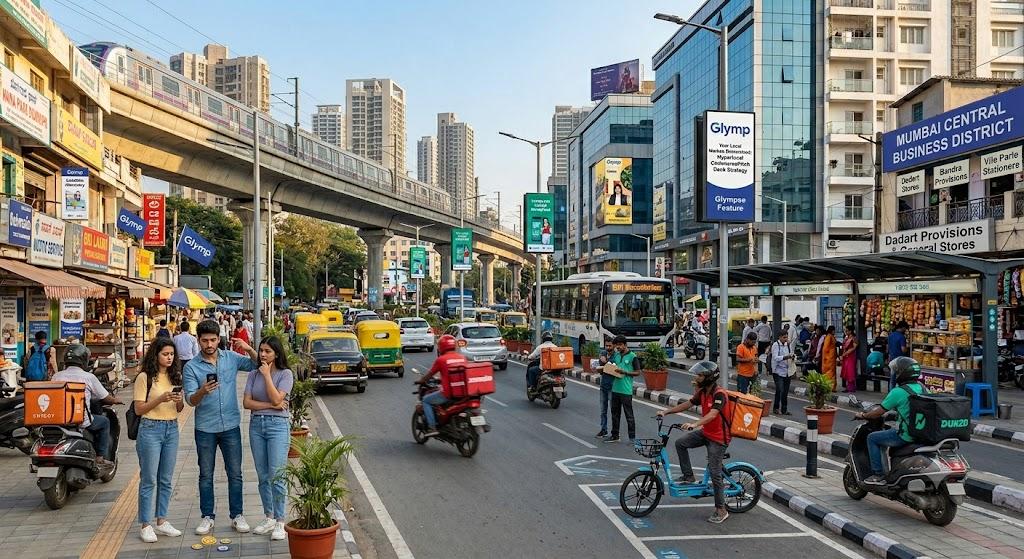
A Small Thought About Where This Goes
Here's what becomes possible when discovery infrastructure is in place. A consumer who can find, evaluate, and trust a local business is a consumer who is ready to transact. Discovery doesn't compete with commerce. It creates the conditions for it.
“The richer the discovery layer, the stronger the commercial layer that can be built on top of it.”
In markets where local discovery has been well-solved, where consumers can reliably find and trust nearby businesses, local commerce becomes a genuinely compelling alternative to national ecommerce across a wide range of categories. The physical presence, the immediacy, the ability to see and touch before buying: these are structural advantages local businesses have always held. They've just never had the digital infrastructure to make them reachable.
A discovery layer that makes local businesses findable and trustworthy at scale doesn't compete with delivery. It is the foundation on which a new kind of local commerce, social, community-driven, deeply rooted in place, can be built.
The delivery layer exists. It works.
What comes before it is still being built.
That's where Glymp is.